
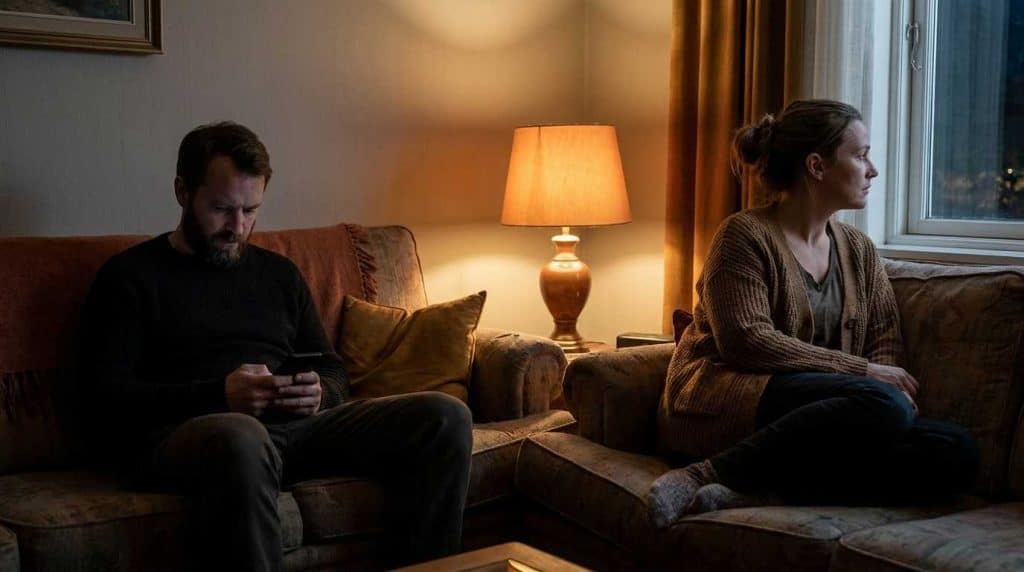
You are not alone. And yet you feel completely alone.
Your partner is right there – across the dinner table, in the same bed, in the next room. And somehow that makes it worse. Because loneliness when you are single makes sense. Loneliness when you are in a relationship is confusing, disorienting, and often accompanied by a quiet shame that stops people from admitting it out loud.
But it is far more common than most people realize. According to licensed clinical psychologist Vagdevi Meunier, writing for the Gottman Institute (2026), feeling lonely in a relationship typically happens when emotional needs are not being met – when poor communication, lack of intimacy, or superficial conversations create distance that physical proximity cannot bridge.
This article looks at seven of the most common reasons people feel lonely in relationships and what can genuinely help. It is not about whether your relationship is good or bad. It is about understanding what is actually happening – which is usually more specific, and more workable, than it feels.
What It Really Means to Feel Lonely in a Relationship
Psychologists define loneliness not as the absence of people, but as the perceived gap between the relationships we have and the relationships we want. You can be surrounded by people – including a partner – and feel this gap acutely.
What makes loneliness in a relationship particularly painful is that the person best positioned to close the gap is right there. When they do not, or cannot, the loneliness acquires a specific quality – not just the absence of connection, but the presence of someone who is not connecting with you. That distinction matters.
A 2025 study published in the Journal of Personality and Social Psychology found something worth sitting with: people who feel lonely in relationships consistently underestimate how much their partners actually care about them. The loneliness itself distorts perception – creating a negative bias that can make genuine care invisible. This does not mean the loneliness is not real. It means that how loneliness feels and what is actually happening in the relationship are sometimes two different things.
7 Real Reasons You Feel Lonely in a Relationship
1. The conversations have become surface-level
Early in most relationships, conversation goes somewhere. You learn things about each other. You share things you have not shared with anyone. Over time, for many couples, conversation narrows – logistics, schedules, the practicalities of a shared life. Perfectly functional. But not particularly connecting.
The Gottman Institute describes this as the difference between turning toward and turning away – the small, repeated moments of reaching for genuine contact versus the small, repeated moments of staying on the surface. Neither is dramatic. But the accumulation matters. Emotional intimacy requires more than proximity. It requires actual contact – the kind that comes from genuine curiosity about what the other person is thinking and feeling, not just what they are doing.
2. You feel unseen or unheard
According to Psychology Today, loneliness within a relationship often centres on the experience of not feeling seen, heard, valued, or understood by a partner. This is distinct from conflict. Your partner may not be doing anything obviously wrong. They may be attentive, kind, present in the room. And you may still feel, somehow, that they are not really seeing you.
This often happens gradually. You stop sharing certain things because they do not seem to land. You stop raising certain feelings because the response is not what you needed. Over time, you edit yourself – not dramatically, but consistently – until the version of you that shows up in the relationship is smaller than the version that exists.
3. Different attachment styles create different needs for connection
One of the most common – and least discussed – sources of loneliness in a relationship is the mismatch between attachment styles. Someone with anxious attachment typically needs more verbal reassurance, more frequent emotional contact, more explicit expressions of closeness. Someone with avoidant attachment may experience closeness through shared activity, physical presence, or practical care – and may genuinely not realize that their partner needs something different.
Neither person is wrong. Both are expressing care in the language they know. But when those languages do not translate to each other, one or both partners can feel genuinely lonely despite a relationship that is, in many ways, functioning. Understanding this dynamic is often one of the most useful things a couple can do – not because it solves the loneliness immediately, but because it reframes it. The loneliness is not evidence that love is absent. It may be evidence that two people are expressing it differently.
4. Phone use and digital distraction are creating physical presence without emotional presence
A 2026 Forbes analysis by psychologist Travis Bradberry describes phubbing – the act of ignoring someone in favour of a mobile device – as one of the most common habits that create loneliness within relationships. The mechanism is straightforward: your partner is physically there, but their attention is elsewhere. You share the space. You do not share the moment.
What makes this particularly erosive is that it rarely feels dramatic enough to name. You do not have a fight about it. You just slowly stop expecting full attention. And the accumulation of that quiet lowered expectation is one of the ways loneliness in relationships builds without anyone noticing until it is quite established.
5. Life transitions have changed the relationship without either of you fully acknowledging it
Having children, changing jobs, moving, losing someone, getting older – any significant life transition changes people. When both partners change at different rates, or in different directions, the relationship can struggle to keep up. You are still together. But the version of each other you fell in love with has evolved, and the relationship has not fully evolved with it.
This kind of loneliness is often accompanied by grief – not for the relationship ending, but for a version of it that no longer quite exists. Acknowledging that grief, rather than pretending everything is the same as it was, is usually the beginning of being able to move forward together rather than separately.
6. Unresolved conflict has created distance that no one is naming
When the same tensions keep surfacing and never fully resolve – when certain topics become no-go zones, when apologies happen without genuine repair – a kind of low-grade distance accumulates. You are not fighting. You are also not quite close. The things that needed to be said went unsaid, and the space where they would have been is now occupied by a careful, managed distance.
A 2023 study published in the Journal of Social and Personal Relationships, cited by Psychology Today, found that loneliness in relationships was associated with more negative partner attributions – meaning lonely people were more likely to interpret their partner’s behaviour through a negative lens, which then increased conflict and reinforced the loneliness. The cycle is self-sustaining, which is part of why naming it directly matters.
7. You have stopped investing in the relationship and are waiting for the other person to
Sometimes loneliness in a relationship is partly a function of what has stopped happening – the small investments of attention, effort, and curiosity that keep connection alive. Both partners stop making them, often without realizing it. And both wait, quietly, for the other to start again.
This is not blame. It is a description of what happens in long-term relationships when the automatic investment of early love gives way to the demands of daily life. The question is not who stopped first. The question is who is willing to start again.
What to Do When You Are Lonely in a Relationship
Name it – to yourself and, when you are ready, to your partner. “I have been feeling lonely recently and I want to feel closer to you” is a different conversation than most couples are having. It is vulnerable and direct in a way that opens something rather than closing it. The Gottman Institute’s guidance on this is consistent: expressing loneliness as a need for closeness rather than a criticism of your partner changes the dynamic significantly.
Get specific about what connection looks like for you. Loneliness is a signal that something is missing – but it does not always tell you exactly what. Is it quality time without phones? Deeper conversation? More physical affection? Being listened to without being advised? Getting specific about what you actually need makes it possible to ask for it, and makes it possible for your partner to actually provide it.
Consider whether the loneliness is relational or personal. Some loneliness in relationships is about the relationship itself – about what is or is not happening between two people. Some of it is more personal – a sense of disconnection from yourself, your sense of purpose, or your life outside the relationship. These are related but different problems, and they call for different responses. A therapist can help distinguish between them.
Look at what you have stopped doing. When did you last ask your partner something you did not already know the answer to? When did you last share something about yourself that felt genuinely new? Reconnection often starts with small acts of genuine curiosity – which sounds too simple, and is also genuinely underestimated. Our guide to why relationships go stale explores this dynamic in more depth.
If the loneliness is chronic and deep, consider couples therapy. Feeling lonely in a relationship is not always solvable through individual effort or better communication alone – particularly when the pattern is longstanding or when there are attachment dynamics at play. Emotionally Focused Therapy has a strong evidence base for addressing exactly this kind of emotional disconnection, and many couples find that even a short course of therapy shifts something that years of trying alone had not.

When Feeling Lonely in a Relationship Becomes Hard to Ignore
Feeling lonely in a relationship does not mean your relationship is failing. It means something specific is missing – and that specific thing is usually more identifiable, and more addressable, than the feeling itself suggests.
The loneliness is worth taking seriously. Not as a verdict on the relationship, but as information about what needs to change. Most of the time, that change starts with saying something honest – to yourself first, and then, when you are ready, to the person sitting across from you.
Frequently Asked Questions
Why do I feel lonely in my relationship?
Loneliness in a relationship typically reflects a gap between the emotional connection you have and the connection you need. Common causes include conversations that have become surface-level, feeling unseen or unheard, mismatched attachment styles, digital distraction creating physical presence without emotional presence, unresolved conflict creating managed distance, and both partners having stopped investing in the relationship. A 2025 study in the Journal of Personality and Social Psychology found that loneliness also distorts perception – making people underestimate how much their partners actually care, which can deepen the experience even when genuine care is present.
Is it normal to feel lonely in a relationship?
Yes – and it is more common than most people admit. Loneliness is not simply the absence of other people. It is the perceived gap between the relationships we have and the relationships we want. Many people in functioning, loving relationships experience this gap at various points. The concern arises when the loneliness is persistent, when attempts to close the gap are unsuccessful, or when it begins to significantly affect wellbeing. At that point, it is usually worth addressing directly rather than waiting for it to resolve on its own.
Can you love someone and still feel lonely?
Yes. Loneliness and love are not mutually exclusive. You can feel deeply attached to someone – genuinely love them – and also feel that the connection between you is not meeting your emotional needs. This often happens when attachment styles are mismatched, when communication has become superficial, or when life transitions have changed both people without the relationship fully adjusting. The loneliness does not cancel the love. It signals that something specific needs attention.
How do I tell my partner I feel lonely without hurting them?
Frame it as a need for closeness rather than a criticism of their behaviour. “I have been feeling lonely and I want to feel closer to you” is different from “you never really talk to me properly.” The first opens a door. The second tends to trigger defensiveness. Being specific about what you need – more quality time, deeper conversation, more physical affection – also helps, because it gives your partner something concrete to respond to rather than a general sense of having failed.
When does loneliness in a relationship become a reason to leave?
When the loneliness is chronic, when direct attempts to address it have produced no genuine change, and when one partner is consistently unwilling to engage with the other’s emotional needs. A period of loneliness is not in itself a reason to end a relationship – most long-term relationships go through phases of greater and lesser connection. But sustained loneliness in which both partners have genuinely tried and one consistently does not show up is different. That requires an honest assessment of whether the relationship has the capacity for the connection you need.