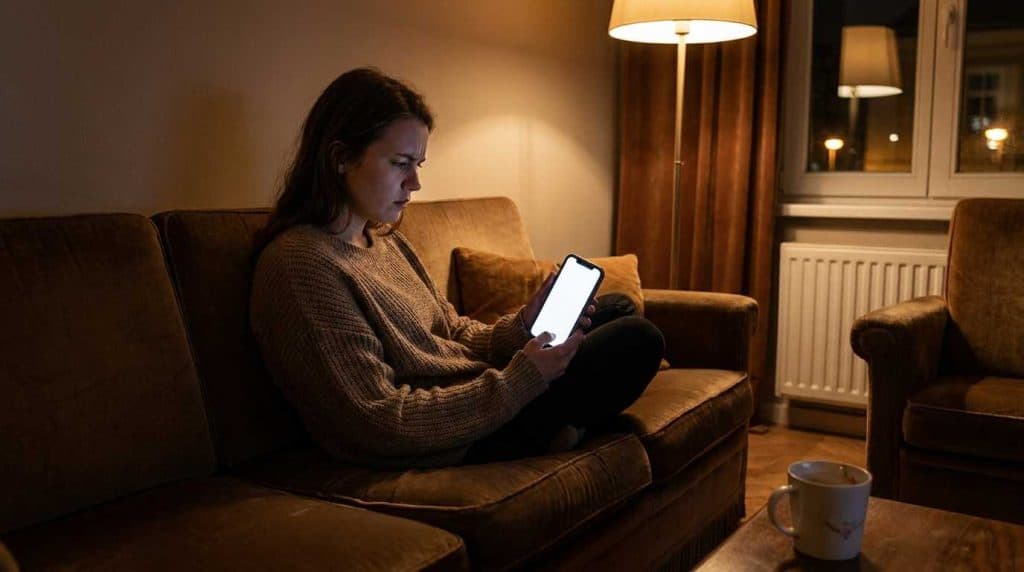
Your partner hasn’t replied for two hours. You know they’re probably just busy. You know this logically, completely, with total certainty.
And yet your stomach is knotted. You’ve checked your phone eleven times. You’re running worst-case scenarios you don’t actually believe but can’t seem to stop generating. The rational part of your brain and the feeling part of your brain are having a very different experience of the same two hours.
If this sounds familiar, you are not overreacting – and you are not alone. Research shows that approximately 35% of people feel genuinely ignored when a message has been read but not answered. And neuroimaging studies confirm that social rejection – including digital silence from someone we care about – activates the anterior cingulate cortex and right ventral prefrontal cortex, the same brain regions that process physical pain, according to research reviewed by Reframe App (2024).
The anxiety you feel when your partner doesn’t text back is not irrational. It is a neurological reality – one that has specific causes, specific patterns, and specific solutions. This article explains all three.
Why Your Brain Reacts So Intensely When Your Partner Doesn’t Text Back
To understand why a delayed text creates genuine distress, you need to understand what your nervous system is actually responding to – and it is not the text.
Your brain’s social rejection circuitry evolved tens of thousands of years ago, in an environment where being excluded from your group could literally mean death. When being separated from the tribe meant genuine danger, the ancestors who panicked when they lost contact were more likely to survive than those who remained calm. That alarm system is still fully operational in your brain today – and it does not distinguish between prehistoric exclusion and a partner who is stuck in a meeting.
What makes this particularly potent in the digital age is the specific psychological mechanism of variable-ratio reinforcement – the same principle that makes slot machines impossible to walk away from. Checking your phone for a reply and finding nothing doesn’t just fail to relieve anxiety. It can actively make it worse. Each check that finds silence is an unpredictable non-reward that keeps the checking behavior going – and the anxiety that drives it escalating. As NeuroLaunch’s 2026 analysis of texting anxiety confirms, this checking cycle is one of the most self-reinforcing patterns in modern relationships.
Recent 2024 studies reveal that delayed electronic responses trigger the same neural pathways as physical abandonment, creating genuine distress that goes far beyond simple impatience. This is not a character weakness. This is your ancient brain doing exactly what it was designed to do in an environment it was never designed for.
The Role of Attachment Style When Your Partner Doesn’t Text Back
Not everyone experiences the same level of anxiety when their partner doesn’t text back. The difference is largely explained by attachment style – the pattern of relating to others that was shaped by your earliest relationships.
People with anxious attachment have a heightened sensitivity to signals of rejection or withdrawal. They tend to monitor their partner’s responsiveness closely and interpret ambiguity negatively. For someone with anxious attachment, a two-hour silence is not neutral information – it is ambiguous information, and the anxious attachment system fills that ambiguity with threat.
People with avoidant attachment tend to experience the opposite – they may feel relief when a partner doesn’t text, because space feels safer than contact. This difference in how digital silence is experienced is one of the most common sources of friction in anxious-avoidant relationships. The avoidant partner thinks nothing of not replying for several hours. The anxious partner experiences those hours as a kind of low-level emergency.
Someone with an anxious attachment style may feel overwhelmed with stress and anxiety if their partner does not respond to their text right away. These responses are shaped by the environment in which they were raised, influencing how they perceive love and intimacy in relationships.
Past Experiences That Make It Worse When Your Partner Doesn’t Text Back
Attachment style is not the only factor. Past relationship experiences also shape how intensely you react to digital silence.
If someone had a negative experience where a partner would frequently ignore their texts and calls as a form of punishment, it is understandable that they might feel anxious when their current partner does not respond immediately. These past experiences can lead to lingering fears and insecurities that are carried into new relationships.
If a previous partner used silence as a weapon – withdrawing communication as punishment or control – your nervous system learned that silence means something is wrong. That learning does not automatically update when you enter a new relationship with a different person. It stays active, interpreting your current partner’s neutral behavior through the lens of your previous partner’s deliberate one.
This is also why the anxiety can feel so disproportionate – because in some sense it is responding to more than just this moment. It is responding to this moment plus the accumulated weight of previous moments where silence meant something real and threatening. If this pattern feels familiar, our guide to overthinking in relationships explores how past experiences fuel present anxiety in detail.
The Self-Fulfilling Cycle of Anxiety When Your Partner Doesn’t Text Back
Relational anxiety, characterized by constant fear of abandonment and obsessive phone-checking when partners are slow to respond, stems from insecure attachment patterns formed in early childhood and reinforced by deep emotional schemas about rejection. People with anxious attachment styles interpret neutral behaviors as signs of rejection, triggering a self-perpetuating cycle where their anxious responses paradoxically push partners away, confirming their fears.
This self-fulfilling quality is one of the most painful aspects of texting anxiety. The anxiety produces behavior – multiple follow-up texts, expressions of hurt or anger when the partner finally replies, demands for reassurance – that can genuinely strain the relationship. The relationship strain then provides real evidence for the original fear, which produces more anxiety. And so the cycle continues.
Understanding this cycle is not about blaming yourself for the pattern. It is about recognizing that the anxiety itself – left unaddressed – creates some of the very conditions it is trying to avoid.
How to Break the Cycle When Your Partner Doesn’t Text Back
Name what is actually happening. When you notice the anxiety rising, name it specifically: “My partner hasn’t texted for two hours and I am feeling anxious about what that means.” This sounds simple but it matters – naming the experience creates a small distance between you and the feeling, making it slightly less automatic.
Apply the outside perspective test. Ask yourself: if a friend told me their partner hadn’t replied for two hours, would I tell them the relationship was over? Usually, applying that outside perspective loosens the grip of the worst-case interpretation. The story your anxiety is generating is almost never the story an objective observer would construct from the same facts.
Resist the urge to check – deliberately. Every time you resist the urge to send a follow-up text or check your phone again, you are building the capacity to tolerate uncertainty. It accumulates slowly, but it does accumulate. Each time you choose not to check, you are teaching your nervous system that the silence is survivable – and that you do not need a reply to be okay.
Build a life that does not wait. The anxiety of an unanswered text is significantly worse when the text is the primary thing you are focused on. Having absorbing activities, genuine friendships, and interests that exist independently of the relationship makes the waiting feel less loaded – because you are not just waiting. You are living.
Have the conversation when it is calm. If texting anxiety is a recurring pattern in your relationship, talking about it directly – not in the moment of anxiety, but in a calm connected moment – is the most effective thing you can do. Not to ask your partner to respond faster, but to share what the experience is like for you and to understand what their communication patterns actually mean. Most partners who are slow to text are not signaling disinterest. They are just people who do not live on their phones.
Consider whether this is pointing to something deeper. If the anxiety is severe, persistent, and significantly affecting your daily life and your relationship, it may be pointing to attachment patterns that are worth exploring with a therapist. Setting clear expectations in the relationship can help – but the deeper work of understanding why silence feels so threatening is often therapeutic work rather than relationship work.
Before You Go
The anxiety you feel when your partner doesn’t text back is not a flaw in your character. It is your nervous system doing what nervous systems do – trying to keep you safe using the tools it has, in a situation those tools were not built for.
The goal is not to stop caring whether your partner replies. The goal is to build enough internal steadiness that a delayed reply stays what it almost always actually is – a delayed reply – rather than becoming evidence of something you have been afraid of for a long time.
That steadiness is buildable. It just takes practice, patience, and sometimes the right support.
Frequently Asked Questions
Why do I get so anxious when my partner doesn’t text back?
Feeling anxious when your partner doesn’t text back is driven by a combination of neurological, psychological, and relational factors. Neuroimaging research shows that social rejection – including digital silence – activates the same brain regions as physical pain. Anxious attachment style heightens sensitivity to any signal of partner withdrawal. Past experiences where silence was used as punishment can make neutral delays feel threatening. And the variable-ratio reinforcement of checking your phone – sometimes finding a reply, sometimes not – creates a compulsive checking cycle that amplifies rather than relieves the anxiety.
Is it normal to feel anxious when your partner doesn’t reply?
Yes – it is extremely common. Research shows that approximately 35% of people feel genuinely ignored when a message has been read but not answered, and the neurological response to digital silence is well-documented. Mild anxiety about an unexpected delay is a normal human response. The concern arises when the anxiety is intense, disproportionate to the actual delay, persistent across relationships, or significantly affecting your daily functioning and relationship quality.
What does texting anxiety say about my attachment style?
Intense anxiety about unanswered texts is most closely associated with anxious attachment style – a pattern of relating that involves heightened sensitivity to signs of rejection or withdrawal, a tendency to interpret ambiguity negatively, and a strong need for reassurance of the relationship’s safety. People with avoidant attachment tend to experience the opposite response to digital silence. Understanding your attachment style is one of the most useful frameworks for making sense of why you respond to unanswered texts the way you do.
How do I stop checking my phone when my partner doesn’t reply?
The most effective approach involves building distress tolerance rather than willpower. Each time you resist checking, you gradually teach your nervous system that the silence is survivable. Practically: put the phone in another room during absorbing activities, apply the outside-perspective test to your worst-case interpretations, and redirect your attention to something genuinely engaging rather than trying to think your way out of the anxiety. If the pattern is severe, working with a therapist on the underlying attachment patterns produces significantly better outcomes than behavioral strategies alone.
Should I tell my partner that unanswered texts make me anxious?
Yes – but timing and framing matter. Raising it in a calm, connected moment rather than immediately after an anxiety spike makes a genuine conversation possible. The goal is not to ask your partner to text faster, but to share your experience and understand their communication patterns. Most slow responders are not signaling disinterest – they simply have different relationships with their phones. That understanding, once established, can significantly reduce the meaning your nervous system attaches to future delays.