
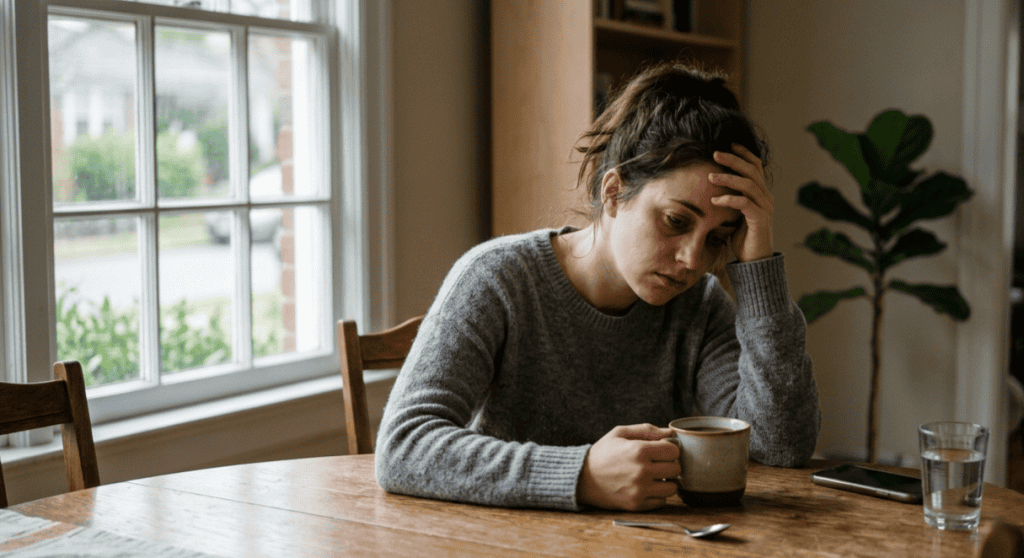
Signs of a toxic relationship are rarely obvious at first. Most people don’t wake up one day and realize what’s happening — it creeps in slowly, through small moments and quiet patterns that are easy to explain away.
“They didn’t mean it like that.” “I provoked them.” “Things will get better when the stress passes.”
Sound familiar?
The truth is, toxic relationships rarely announce themselves. They move in through gradual shifts that are easy to miss — especially when you love the person. And by the time something feels seriously wrong, you’ve already spent months or years making excuses.
This article lays out 10 of the clearest red flags. Not to scare you. But because recognizing what’s happening is always the first step toward changing it. If you’re also struggling with common relationship problems, that article is a good place to start as well.
1. You’re Always Walking on Eggshells
You think carefully before you speak. You monitor their mood the moment they walk through the door. You edit yourself constantly — what you say, how you say it, even what you feel — because you never quite know what will set them off.
This low-level anxiety becomes your normal. But it isn’t normal. In a healthy relationship, you should feel safe to be yourself — including the parts of you that are imperfect, tired, or frustrated.
If you’re spending more energy managing your partner’s reactions than actually connecting with them, that’s a red flag worth paying attention to.
2. They Make You Feel Like Everything Is Your Fault

After every argument, somehow you end up apologizing — even when you’re not sure what you did wrong. Their bad mood is because of something you said. Their reaction is because of how you behaved. Their unhappiness is, ultimately, your responsibility.
This pattern is called blame-shifting, and it’s one of the most common tactics in toxic relationships. Over time, it quietly destroys your confidence and your ability to trust your own judgment.
Ask yourself: when did you last feel genuinely supported after a conflict — rather than responsible for causing it?
3. Your Feelings Are Dismissed or Minimized
You try to express that something hurt you. Instead of being heard, you’re told you’re too sensitive. Too emotional. That you’re overreacting. That it wasn’t a big deal.
This is called emotional invalidation — and it’s one of the most damaging patterns in a toxic relationship. When your feelings are consistently dismissed, you start to doubt them. You learn to suppress what you feel to avoid conflict. And eventually, you stop expressing yourself altogether.
Your emotions are real. They deserve to be acknowledged — not weaponized against you.
4. They Isolate You From People You Love

It starts subtly. They don’t like your best friend. Your family “causes drama.” Your coworkers are a bad influence. One by one, your outside relationships become sources of conflict.
So you see your friends less. You skip family dinners to avoid the argument afterward. Your world quietly shrinks — until the only person you consistently turn to is them.
Isolation is one of the most deliberate tactics in controlling relationships. It removes your support system, making you more dependent — and making it harder to leave.
5. There’s a Constant Push and Pull
One week they’re loving, attentive, and everything feels right. The next they’re cold, distant, or cruel — and you’re left confused, trying to figure out what changed.
This cycle — sometimes called intermittent reinforcement — is one of the most psychologically powerful dynamics in toxic relationships. The unpredictability keeps you hooked. The good moments feel like proof the relationship is worth staying for. The bad moments feel like something you need to fix.
But you can’t fix a cycle that isn’t yours to fix.
6. They Use Guilt, Fear, or Obligation to Control You
Healthy influence in a relationship looks like honest conversation. Toxic control looks like:
- “After everything I’ve done for you, you can’t do this one thing?”
- “If you really loved me, you wouldn’t need to see your friends so much.”
- “Fine. I’ll just be alone then.”
- “You know what happens when you make me angry.”
These statements aren’t communication — they’re manipulation. They use your love, your guilt, or your fear to steer your behavior. And they’re designed to make you feel like the problem when you push back.
7. Your Self-Worth Has Quietly Eroded
You used to feel confident. Capable. Sure of yourself. But somewhere along the way, that changed.
Maybe it was the small digs that didn’t seem like a big deal at the time. The jokes at your expense in front of others. The comparisons. The “constructive criticism” that always seemed to land like an attack.
One of the clearest signs of a toxic relationship is looking back and realizing you think less of yourself than you did before you entered it. That’s not growth. That’s damage.
8. They Deny Things You Know Happened
“I never said that.” “You’re imagining things.” “That’s not how it happened — you’re remembering it wrong.”
If your partner regularly denies or rewrites reality, you may be experiencing gaslighting — a form of psychological manipulation that makes you question your own memory, perception, and sanity.
Over time, gaslighting is deeply disorienting. You stop trusting yourself. You defer to their version of events. You become dependent on them to tell you what’s real.
If you find yourself constantly second-guessing your own experience, trust that feeling. Your memory is more reliable than they want you to believe. We cover gaslighting in detail — read the full article here.
9. The Relationship Feels One-Sided
You’re the one who apologizes. You’re the one who adjusts. You’re the one who makes sacrifices to keep the peace. You put in effort — and what comes back doesn’t match what you give.
All relationships have imbalances at times. Life gets complicated. But when the imbalance is consistent — when you’re always the one doing the emotional labor while they coast — it stops being a rough patch and starts being the core dynamic of a toxic relationship. Psychology Today notes that one-sided effort is one of the strongest predictors of long-term relationship dissatisfaction.
A relationship should feel like a partnership. Not a performance you give while they watch.
10. You’ve Lost Sight of Who You Are
Your interests have faded. Your friendships have thinned. The things you used to care about feel distant. You’ve spent so long adapting to this relationship — to their moods, their needs, their version of who you should be — that you’ve lost track of your own.
This is perhaps the most heartbreaking sign of all. Because it doesn’t happen dramatically. It happens quietly, across hundreds of small moments of self-erasure.
But here’s what matters: losing yourself in a relationship doesn’t mean you’re gone. It means you have something worth reclaiming.
What to Do If You Recognize These Signs
First — take a breath. Recognizing what’s happening is significant. It’s not easy to see clearly when you’re inside it.
- Trust what you’ve noticed. You’re not overreacting. You’re not too sensitive. If something has felt wrong, there’s likely a reason.
- Talk to someone you trust. A friend, a family member, a therapist. Isolation thrives in silence — breaking that silence matters.
- Don’t make major decisions alone or in crisis. Whether to stay, leave, or try to repair things is a real decision that deserves space and support.
- Consider professional help. A therapist — individual or couples — can help you see patterns more clearly and figure out what you actually want.
Understanding why these dynamics happen often comes down to deeper patterns. Learn how attachment styles make some people more vulnerable to toxic relationships.
A Final Word
Toxic relationships are not always obvious. They don’t always involve shouting or physical harm. Sometimes they look like love — intense, consuming, complicated love that keeps you hoping things will go back to how they were at the beginning.
But love — real love — doesn’t ask you to shrink. It doesn’t make you feel crazy, small, or perpetually at fault.
You deserve to be in a relationship where you feel safe, seen, and valued. Not just sometimes. Consistently.
That’s not too much to ask. That’s the baseline.
Frequently Asked Questions
What are the signs of a toxic relationship?
The most common signs include walking on eggshells, constant blame-shifting, emotional invalidation, isolation from friends and family, gaslighting, one-sided effort, and a gradual erosion of your self-worth. These patterns are often subtle at first and become more pronounced over time.
Can a toxic relationship be fixed?
Some toxic dynamics can improve if both partners genuinely acknowledge the problem and commit to change — often with the support of couples therapy. However, if the toxic behavior involves manipulation or abuse, and your partner shows no willingness to take responsibility, the relationship is unlikely to change.
What is the difference between a toxic relationship and an abusive one?
Toxic relationships involve harmful patterns — manipulation, control, emotional invalidation — that damage your wellbeing over time. Abusive relationships involve deliberate harm, whether emotional, psychological, or physical. The line between the two can blur, and many toxic relationships escalate into abuse. If you feel unsafe, please reach out to a professional or helpline.
Why do people stay in toxic relationships?
People stay for many reasons: love, hope that things will change, fear of being alone, financial dependence, isolation from support systems, low self-worth developed within the relationship, and trauma bonding — a psychological attachment that forms through cycles of tension and relief.
How do toxic relationships affect mental health?
Toxic relationships are strongly linked to anxiety, depression, reduced self-esteem, and symptoms of PTSD. The constant stress of managing an unpredictable partner keeps the nervous system in a state of alert, which takes a significant toll on mental and physical health over time.